Introduction
Customer relationships are fragile.
One unresolved issue, one frustrating product experience, or one ignored question can prompt a customer to explore alternatives.
Yet for many organizations, the moment of churn feels sudden only because the warning signs never appeared in their community or support systems.
Platforms like Salesforce and Zendesk are designed to track structured customer interactions—support tickets, emails, chat conversations, and service cases.
But today’s customers don’t always begin their support journey by opening a ticket.
Many start by searching for answers in online community platforms, where they ask questions, discuss product challenges, and exchange solutions with other users. These conversations often take place in communities hosted on platforms such as Higher Logic Vanilla, Khoros, and more.
But without community-support integration, these conversations remain disconnected from core support workflows.
This is where the gap begins, which leads to silent churn.
In this post, we explore these visibility gaps and how sentiment analysis, combined with community–support integration, turns forum conversations into actionable insights. We also examine how an online community and support integration platform strengthen online community retention.
Let’s get started!
TL;DR:
- Silent churn often starts quietly in community forums before customers submit support tickets.
- Traditional support systems are reactive and miss early warning signals.
- AI-driven sentiment analysis interprets customer emotions across community conversations.
- Integrating these insights into support platforms enables:
- Early detection of dissatisfaction
- Prioritization based on emotional urgency
- Proactive engagement with at-risk customers
- Community-support integration tools turn unstructured conversations into actionable insights, helping businesses prevent churn and improve retention.
The Data Gap: Why Support Platforms are Fundamentally Reactionary
Traditional support workflows are built around explicit customer actions.
A customer encounters a problem, submits a ticket, and the system records the interaction. Support teams then investigate and resolve the issue. This workflow works for reported problems, but many early warning signs never reach this stage.
Often, customers start by seeking answers in community forums. Here’s what typically happens:
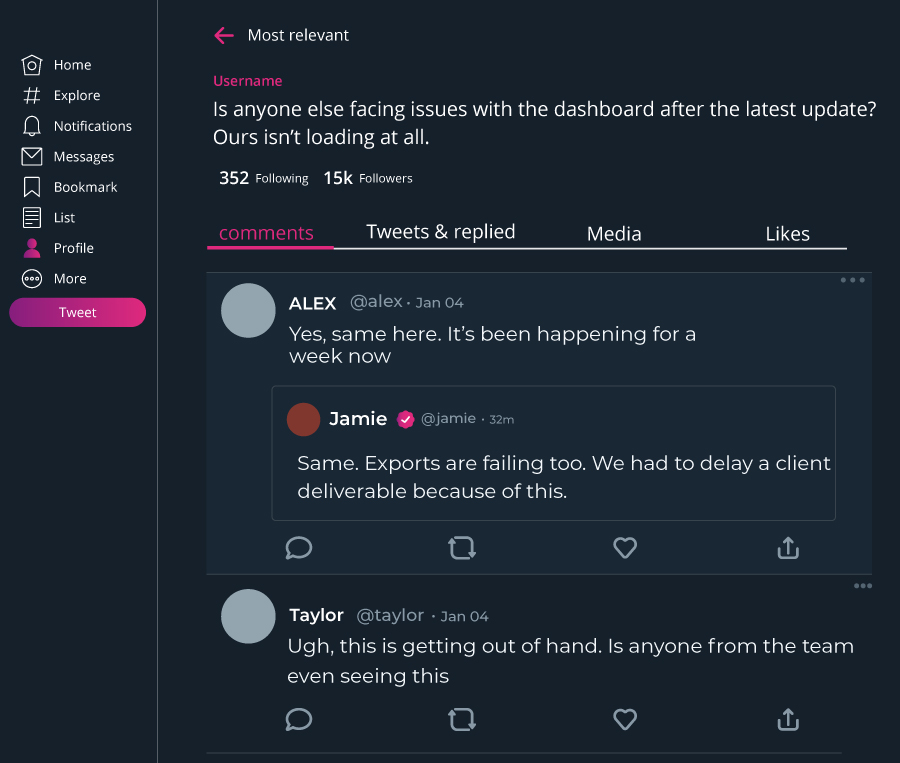
While the community sees the issue unfolding, the support platform does not, because no ticket has been created. In other words, without online community and support integration, this entire thread remains invisible to support teams.
As a result, teams miss critical signals about customer intent and sentiment. It is within this gap—between what customers experience and what systems capture—that silent churn begins to take shape.
The Silent Churn: The Consequence of Missed Signals
Silent churn occurs when early signals go unnoticed, and customers begin to disengage quietly. Rather than reporting issues, they often:
- Try to resolve issues independently
- Reduce usage of the product over time
- Avoid contacting support, leaving teams unaware
Because these behaviors happen quietly, traditional support systems rarely detect them. In fact, research shows that 97%[i] of users churn silently—meaning the vast majority leave without ever voicing their complaints.
For companies relying heavily on Salesforce case deflection strategies, this risk is even higher if sentiment is not monitored alongside deflection.
This is where monitoring community conversations becomes critical, helping teams surface early signals that would otherwise go unseen.
The Hidden Voice: Turning Community Conversations into Sentiment Signals
Community discussions contain a rich layer of emotional context.
Every post, reply, or thread reflects a customer’s experience with the product, whether positive, neutral, or negative.
Sentiment analysis uses Natural Language Processing (NLP) to evaluate emotional tone, enabling organizations to interpret large volumes of community conversations at scale.
Instead of manually reviewing threads, it can automatically identify patterns such as rising frustration around specific features, repeated complaints across discussions, and declining sentiment within customer accounts.
These insights transform community platforms from passive discussion spaces into early warning systems for customer risk, especially when powered by strong community-support integration.
From Detection to Action: How Sentiment Analysis Prevents Silent Churn in Online Communities
When community sentiment is brought into support systems, issues no longer have to be reported to be recognized. Community–support integration makes this possible through three key capabilities.
Automated Escalation:
Negative sentiment detected in a community discussion can automatically trigger a case in the support platform. This ensures that issues receive attention even when customers do not explicitly request support.
Proactive Customer Success Outreach:
Sentiment patterns across community discussions can highlight accounts experiencing repeated friction. When an account’s aggregate sentiment drops, Customer Success Managers can be alerted to intervene early and address concerns before they escalate further.
Sentiment-Based Prioritization:
Traditional support queues prioritize technical severity. Sentiment analysis adds another dimension, emotional urgency, enabling teams to prioritize accounts showing a heightened concern.
Together, these capabilities shift support operations from reactive problem-solving to predictive customer experience management.
These results are not incidental. They reflect a fundamental difference in how customer issues are identified and addressed. This difference becomes clearer when we compare traditional support models with sentiment-driven approaches.
| Comparative Analysis: Reactive vs Sentiment-Driven Support |
||
|---|---|---|
| Aspect | Traditional Reactive Support | Sentiment-Driven Support |
| Trigger | Manual Support Ticket | AI Analysis of Community Conversations |
| Timing | After Frustration Peaks | Early Detection Before Escalation |
| Data Source | Isolated Support Platforms | Unified View (Community + Support Insights) |
| Risk Discovery | Often, During Renewal Cycles | Continuous Sentiment Monitoring |
| Response Style | Generic Problem Investigation | Context-Aware Intervention |
| Outcome | Higher Churn Risk | Stronger Retention and Customer Loyalty |
By closing the gap between community and support platforms, companies move from reactive support to sentiment-driven support.
Bridging the Sentiment Insights: How Community-Support Integration Solves Visibility Gaps
Detecting sentiment signals is only the first step. To create real operational impact, those insights must flow into the systems where support and customer success teams work.
This is where KaseSync plays a critical role. Designed and developed by Grazitti Interactive, KaseSync is an intelligent bridge that eliminates data silos through community-support integration.
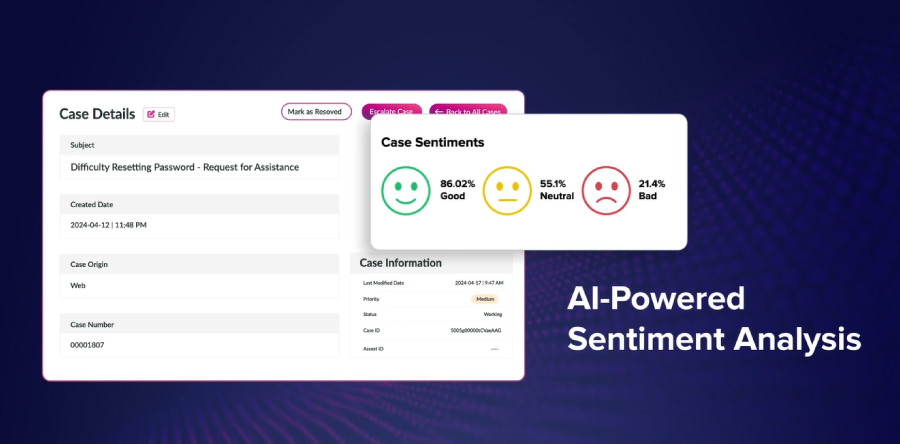
It continuously monitors conversations across community platforms, applying AI-driven sentiment analysis to classify interactions as positive, neutral, or negative. These insights are then synchronized directly with support platforms, such as Salesforce and NetSuite, and more.
With this connection in place, sentiment signals become immediately actionable, allowing teams to move from passive observation to active response, with insights directly shaping how support is prioritized and delivered:
- Automatic case creation when negative sentiment is detected
- Real-time sentiment visibility within customer records
- Priority alignment based on customer sentiment, not just ticket severity
- Proactive engagement with at-risk accounts
Beyond escalation, features such as case deflection and intelligent routing help teams deliver faster, more relevant responses while reducing operational load.
For businesses, the result is not just better visibility, but a fundamental shift in how teams operate. Support teams move from isolated tickets to complete context. Customer success teams move from periodic check-ins to continuous insight. Organizations move from delayed reactions to early intervention.
Also Read: Harnessing AI for Enhanced Support Management: Introducing KaseSync’s Sentiment Analysis
Conclusion: From Visibility to Retention
Silent churn doesn’t happen suddenly. It builds over time, in conversations that never make it to support systems and signals that go unnoticed.
That’s the real gap.
Community–support integration, combined with sentiment analysis, closes it by turning unstructured conversations into actionable insight within the systems where teams actually work. With solutions like KaseSync, organizations can detect early signs of dissatisfaction, automate escalations, and step in before issues start affecting retention.
At that point, support is no longer just about resolving tickets. It becomes about understanding customer experience as it unfolds.
References
[i]: Mixpanel
[ii]: Supportbench
Tags
Frequently Asked Questions
Silent churn happens when customers disengage without submitting support tickets or complaints. It often starts with small frustrations in community discussions that go unnoticed until renewal time.