The Hidden Cost of Operating Without Community and Support Integration
A customer named Jacob posts a question in your community. The post receives partial answers, so he contacts support. Your support agent reviews the ticket without visibility into the community conversation and answers by shooting an arrow in the blind spot.
Meanwhile, a similar discussion is happening with another customer. Sounds like a common scenario. This disconnect between an online community and a support platform leads to communities being in a discussion-only mode.
Customers like Jacob have to switch to a support platform like Salesforce for assistance. This fragmentation across different touchpoints weakens the support ecosystem, quietly eroding Jacob’s trust and engagement.
However, that’s not all. When a business runs its support and online community platforms separately, the real cost goes much deeper. In this blog post, we will break down the often-overlooked costs of operational fragmentation and demonstrate the value of community and support integration.
Why Fragmented Community and Support Platforms Cost More Than You Realize
Operating without a seamless integration between your community and support platforms creates a significant “success gap” that most organizations fail to recognize.
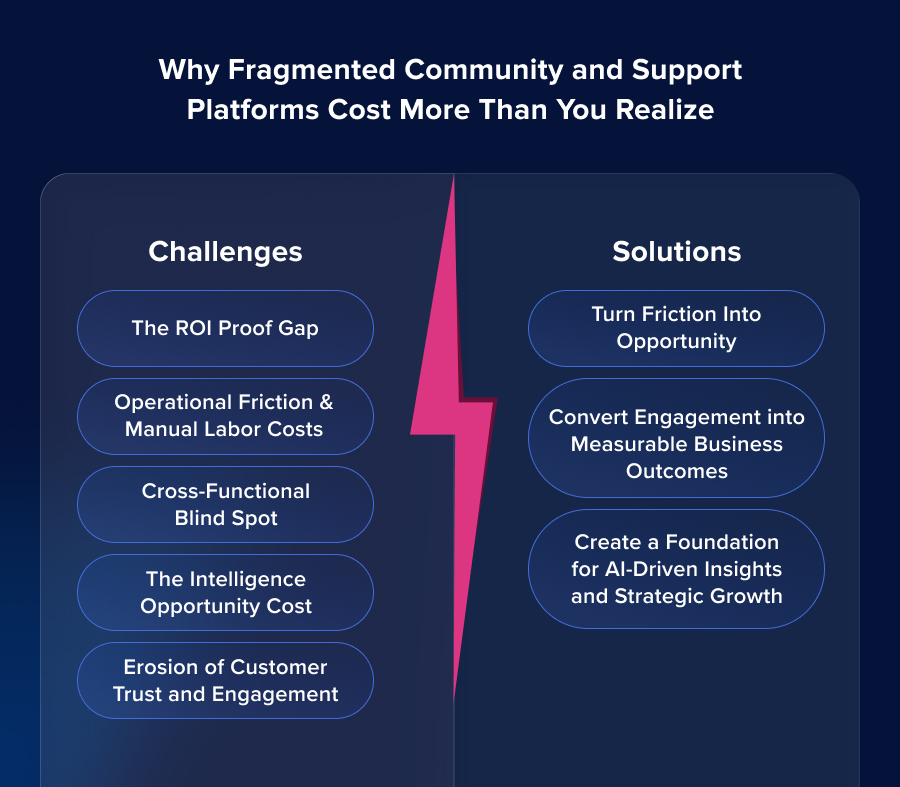
The ROI Proof Gap
The most immediate consequence of disjointed platforms is the inability to demonstrate value clearly. Teams with support-integrated community data are more than twice as likely to rate their impact as “extremely successful” (24% vs. 11.5%)[i]. Without integration, community outcomes remain anecdotal, making it harder to link engagement to cost savings, case deflection, or CSAT. This lack of visibility weakens leadership confidence and makes community investments difficult to defend when budgets tighten.
Operational Friction & Manual Labor Costs
When community and support platforms aren’t integrated, lean teams absorb the cost, with 30%[ii] of professionals reporting that their efforts are largely manual. Their time is lost reconciling data, duplicating effort, and managing fragmented workflows. As teams stretch, higher-impact functions like operations, designing community experiences, and proactive engagement are often the first to fall off the priority list.
Cross-Functional Blind Spot
Community discussions surface recurring issues, emerging trends, and user-generated solutions. Without integration, this intelligence never feeds into support analytics or leadership decision-making. Support teams remain reactive instead of preventive, missing opportunities to address root causes, deflect tickets at scale, or inform product direction. The cost here isn’t just inefficiency; it’s missed market insight and stalled innovation.
The Intelligence Opportunity Cost
AI adoption is rising, with 81%[iii] of professionals already using AI tools. However, when community data remains siloed outside your support, it creates an “Intelligence Gap.” Without this data, AI lacks visibility into customer sentiment, i.e., what customers are feeling, discussing, and reacting to, making it harder for teams to understand intent, spot early signals, and respond effectively across the customer journey.
Erosion of Customer Trust and Engagement
Fragmentation forces customers to switch platforms, repeat context, and navigate disjointed experiences—raising cognitive load and increasing the likelihood of abandoned requests or duplicate tickets. Over time, these small friction points quietly erode brand perception and engagement, often surfacing well before dissatisfaction is reflected in CSAT scores or churn metrics.
Why is Community–Support Integration Key to a Future-Ready Ecosystem?
Support platforms are at the center of today’s customer assistance. But when a community operates outside the support ecosystem, critical insights remain underutilized.
Community–support integration changes this by bringing those insights directly into the support workflow. The result is not just better alignment but a set of tangible operational advantages.
Turn Friction Into Opportunity
When community insights feed directly into support workflows, agents can leverage this knowledge to resolve issues faster and more effectively. At the same time, the community benefits from timely, visible solutions, turning interactions into shared wins. This integration between community and support strengthens connections, humanizes the experience, and encourages peer-to-peer collaboration, creating loyalty and advocacy.
Convert Engagement into Measurable Business Outcomes
Community–support integration channels interactions into quantifiable results, helping organizations track retention, efficiency, and revenue. Teams can measure outcomes such as reduced ticket volumes, improved adoption, faster resolutions, and higher customer lifetime value. Beyond metrics, this integration enables data-backed storytelling, making it easy for CX teams to communicate value to the C-suite, justify investments, and guide strategic decisions, turning community interactions into concrete business wins.
Create a Foundation for AI-Driven Insights and Strategic Growth
The future of CX is AI-powered, but siloed data limits algorithms from accessing the diverse, real-time inputs they need. Community–support integration unifies unstructured forum chatter with structured ticket logs, enabling AI-driven sentiment analysis. These insights help teams deliver more personalized, context-aware support, strengthen customer trust, and improve overall experience—making integrated ecosystems the backbone of responsive, customer-centric support.
This is where a seamless community–support integration tool like KaseSync becomes critical. It redefines the support ecosystem with a data-backed strategy. Let’s explore more.
How KaseSync Bridges the Gap Between Community and Support Platforms
Developed by Grazitti Interactive, KaseSync is more than a community support integration solution. It’s a strategic CX enabler that transforms feedback into insight and builds communities that solve problems, share knowledge, and drive measurable ROI.
Key Features of KaseSync
- Unified Case Management: Create, escalate, and track support cases directly from the community—without switching platforms.
- Bi-Directional Synchronization: Keep case updates, comments, and status changes aligned across community and support systems in real time.
- Intelligent Case Deflection: Surface relevant discussions and knowledge articles before a case is created, reducing unnecessary tickets.
- Partner Workflows & Unlimited File Uploads: Enable seamless collaboration across internal teams and external partners.
- Platform Integrations: Integrates with Salesforce, Zendesk, ServiceNow, Khoros, Higher Logic Vanilla, Gainsight, and more.
How KaseSync Boosts Operational Efficiency ROI
Beyond improving the customer experience, KaseSync reduces operational complexity and costs. Let’s explore.
- License Cost Optimization
KaseSync lowers support platform licensing costs by enabling support workflows to run directly through the community, without requiring full CRM access for every participant. For example, organizations paying approximately $100 USD per user per month for Salesforce Service licenses often extend access to external users such as customers or partners. With 100 external support users, the cost can reach up to $120,000 annually.By managing these workflows through the community, KaseSync allows external users to engage in support without full licenses. Only essential internal teams retain paid access, helping organizations reclaim tens of thousands of dollars per year, depending on license mix and contract terms.
- Higher Case Deflection and Faster Resolution
With integrated case creation and real-time synchronization, users are more likely to find relevant answers before escalation. Teams report up to an 18% increase in case deflection, reducing ticket volume and agent workload. - Increased Community Engagement and Responsiveness
Integrated escalations and visible resolution paths encourage participation and trust. Many organizations see around a 30% increase in community engagement, as users receive timely updates and clearer outcomes.
Additionally, KaseSync helps organizations transform online communities into living knowledge hubs through seamless support platform integration. This builds trust, drives advocacy, and strengthens brand credibility, making the ROI go beyond numbers.
Conclusion
Community-support integration is crucial for a future-ready ecosystem where every interaction fuels progress. By embracing these advantages through a community-support integration tool like KaseSync, organizations can evolve from reactive support to proactive partnership, cultivating ecosystems that not only resolve issues but also inspire enduring loyalty from customers like Jacob.

Reference
[i], [ii] & [iii]: CMX
Frequently Asked Questions
- What is the hidden cost of running community and support platforms separately?
When community and support platforms operate in silos, organizations lose visibility into ROI, customer sentiment, and emerging issues. This disconnect breaks the link between engagement and measurable outcomes, weakening decision-making long before the impact appears in CSAT or churn metrics.
- Why does fragmented community and support data make ROI hard to prove?
Fragmentation breaks the link between community activity and measurable outcomes such as ticket deflection, cost savings, or resolution efficiency. Without integrated data, community value remains intangible, making it difficult for teams to demonstrate ROI or justify continued investment to leadership.
- How does community–support integration improve customer experience?
Integration reduces friction by eliminating platform switching and repeated explanations. Customers get faster, more contextual responses, while support teams gain visibility into prior community interactions, resulting in smoother journeys and stronger trust.
- How does KaseSync help integrate community and support platforms?
KaseSync connects community platforms like Higher Logic Vanilla with leading support tools through unified case management, bi-directional synchronization, intelligent case deflection, and sentiment visibility. This turns community engagement into actionable support intelligence and measurable ROI.